Genres
Jazz Music History and Appreciation
Modified: 3 October 2026
Table of Contents
First questions: what jazz music history actually means
To understand jazz music history and what makes the genre tick, it helps to start with what is unique about jazz and what makes its different from other types of music. In many genres, a musician follows a fixed part, but in jazz the rhythmic energy, improvisation, and the way musicians listen and balance with one another while still expressing individual personalities are the entire point of the performance.
Among the characteristics of jazz music, the most immediate is improvisation, the feeling that the solo is being created on the spot. This is paired with a rhythmic drive that mirrors dance motion and the inflections of human speech. That rhythmic core is often called swing in jazz, best understood as a propulsive, uneven momentum that makes you want to move or snap your fingers, rather than just a single style for dancing with large ensembles.
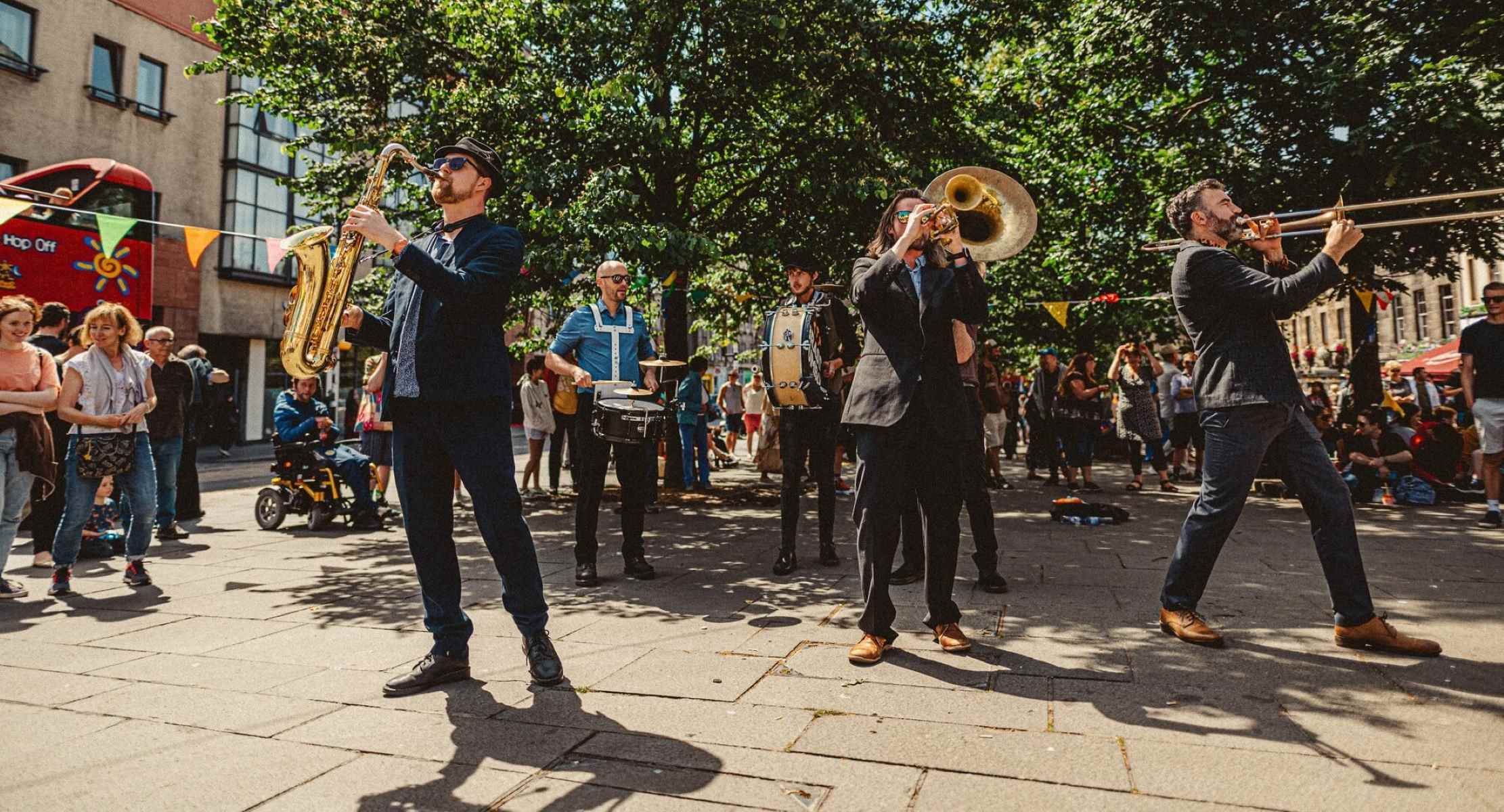
Because of this physical pull and conversational freedom, how does jazz make you feel can range from the thrill of a collective street parade to the deep focus of a late-night club set, proving that the genre is far wider than any one polished radio format.
To experience the music properly, being in the room is one powerful way. Consider attending a live big band performance at a historic venue, arriving early to secure a seat with clear sightlines to the piano, as musicians often feed off your audible reaction to fuel the improvisation.
Jazz is a door that has never really closed, which is why the music today can hold intricate chamber compositions, electronic textures, and hip-hop all at once. Your task is to listen for the conversation, focusing on how the bass and drums lock in to create the pocket and noticing when the saxophonist quotes a melody from a completely different song during a solo. This is the language of the idiom, and it is built on split-second trust.
Do not treat the history as a static timeline. Start your listening with Louis Armstrong’s Hot Fives to hear the emergence of the soloist, then explore the dense harmonies of Charles Mingus. From there you can attend a live performance and stand close to the stage to watch the drummer’s hands and see exactly how swing is not a flat rhythm but a living, breathing pulse.
The roots and birth of jazz
What we now call jazz began as a fusion of several distinct musical streams meeting in New Orleans, making it impossible to separate the music from the genres that shaped jazz. The two most direct ancestors were ragtime, with its syncopated piano propulsion, and the blues. The blues was a vocal and instrumental language that had been developing since the Civil War. All of these fed its distinctive flattened notes and call-and-response phrasing. The blues influence on jazz went far deeper than borrowed scales; exploring that link reveals how the blues supplied the freer phrasing, the improvised breaks, and the emotional directness that early jazz players turned into a new kind of collective conversation. By the time the music traveled north and entered the national bloodstream, it had become so central to American life that the Jazz Age label of the 1920s was coined by writers like F. Scott Fitzgerald to capture an entire era's restless, modern energy. That was not just a nickname. jazz's impact on the 1920s reshaped entertainment from the ground up, driving the phonograph boom, defining youth culture, and making the decade's dance floors and speakeasies pulse with a sound that had grown from street parades into a dominant popular art, a transformation that the article on the subject documents in full.
- music theory what characterizes the blues — Music Theory What Characterizes The Blues
- jazz's impact on the 1920s — How Did Jazz Impact The 1920S
- blues influence on jazz — How Did Blues Influence Jazz
How jazz evolved across eras
To trace the full arc of jazz evolution over decades, it helps to picture each major shift as a direct response to what came before. Early New Orleans polyphony gave way to the tighter arrangements of the swing era. By the 1940s musicians were pushing back against the dance-band formula. That is where bebop's difference from earlier jazz becomes unmistakable. Instead of steady four-to-the-floor rhythms and singable melodies, players like Charlie Parker and Dizzy Gillespie introduced breakneck tempos, angular harmonies, and a focus on virtuosic improvisation. This turned the music from popular entertainment into a more cerebral art form. The next generation sought a middle ground. Hard bop jazz answered by grounding bebop's complexity in bluesy, gospel-rooted feeling and groove-heavy backbeats. That pendulum kept swinging. By the 1960s, the principal jazz avant-garde musicians, including Ornette Coleman and Cecil Taylor, dismantled chord changes and fixed meter entirely. They treated collective freedom as a new organizing principle. Their experiments opened a door that has never really closed, which is why jazz like today can include everything from intricate chamber compositions to electronic textures and hip-hop crossovers. All of it remains in dialogue with the same restless lineage.
The language of jazz performance
At the heart of the music lies the solo in jazz, a moment where a player steps forward to compose a new melody in real time over the song’s underlying structure, and beginners often feel pressure to fill every beat. Starting simply with chord tones and leaving deliberate space creates a more compelling conversation than a rush of notes. The same instrumental impulse translates directly to the human voice through scat singing in jazz, where the singer abandons lyrics entirely and uses percussive, wordless syllables to mimic a horn or a bass line. On a lead sheet, the harmonic roadmap for these improvisations relies on a streamlined shorthand, and seeing a triangle mean in jazz chords signals a major seventh sonority, so a symbol like C△ tells the pianist or guitarist to voice a C major 7 rather than a plain triad. When musicians sit down to write jazz music, they craft a flexible framework of melody and changes, and the finished composition remains intentionally open-ended to spark spontaneous interpretation.
The giants who defined the sound
If you trace the thread of Armstrong's jazz influence back to its source, you hear a musician who fundamentally rewrote the rules by shifting the spotlight onto the soloist. He transformed a collective street-parade tradition into a music where individual improvisation and personal expression became the driving force. That same impulse toward a distinct sonic identity runs through Duke Ellington's jazz contributions, which reimagined the big band not as a standardized dance machine but as a richly textured palette of individual tone colors. He wrote parts tailored to the specific sound of players like Johnny Hodges and Cootie Williams. Later, he stood at the forefront of free jazz’s boundary-dissolving energy.
- Duke Ellington's jazz contributions — What Did Duke Ellington Contribute To Jazz
- John Coltrane's jazz significance — Why Is John Coltrane Important To Jazz
- popular 1950s jazz musicians — Who Were The Three Most Popular Jazz Musicians In America In The 1950S
- Duke Ellington's jazz style — What Kind Of Jazz Is Duke Ellington Known For?
- Armstrong's jazz influence — What Did Louis Armstrong Contribute To Jazz
- Miles Davis jazz style — What Style Of Jazz Did Miles Davis Play
Jazz as a social and cultural force
When the Harlem Renaissance took hold in the 1920s, jazz's significance in the Harlem Renaissance lay in how it became the soundtrack for a flourishing of Black art and literature, with musicians like Louis Armstrong and Duke Ellington collaborating directly with writers to forge a new, self-confident cultural identity.
That explosion of creativity happened in clubs and dance halls, but it was the speakeasies' impact on jazz during Prohibition that turned thousands of illegal bars into a nationwide underground circuit where performers advanced their careers by making a living playing the music they wanted to play.
As the music spilled out of those hidden rooms, jazz's societal impact registered far beyond the bandstand, seeping into poetry, painting, cinema, and even the way people talked, while becoming tightly woven into the push for social and legal equality.
Tracing jazz music's influences outward, you can hear its DNA in the rhythmic phrasing of rock and R&B, as well as in the narrative structures of mid-century fiction and the visual improvisations of abstract expressionist painting.
Just as important are the influences on jazz music itself, which absorbed the blues idioms of the Deep South, the syncopated rhythms of ragtime, and the call-and-response patterns of the Black church, then reshaped them into something that felt entirely new yet deeply rooted.
- jazz's significance in the Harlem Renaissance — Why Was Jazz Important In The Harlem Renaissance
- speakeasies' impact on jazz — How Did The Rise Of Speakeasies During Prohibition Affect Jazz Musicians?
- jazz music's influences — What Did Jazz Music Influence
- jazz's societal impact — How Did Jazz Music Affect Society
Navigating jazz subgenres and debates
Stepping from the early innovators into the modern era means confronting a genre that has splintered into fiercely debated camps. The very definition of authenticity is up for grabs. A listener moving from Coltrane’s spiritual quest directly into a track defined by its polished production and gentle, looping grooves will immediately hear that smooth jazz characteristics prioritize atmosphere and melody over the kind of risk-taking improvisation that defined hard bop. To understand why some listeners gravitate toward this accessible sound, you will want to read the article on smooth jazz characteristics for a clear breakdown of its signature elements. This commercial shift is precisely what fuels the dislike of smooth jazz. Critics argue it sands away the music’s rebellious edge to create a product that is soothing but static. Before you pick a side in that debate, it is helpful to clarify a deeper roots question. Understanding the difference between blues and jazz music often resolves the confusion: blues typically channels raw, individual emotion through a tighter, verse-based structure. Jazz evolved as a more communal conversation where the collective interplay and varied instrumentation open up a wider expressive range. You would want to understand the difference between blues and jazz music to see how each tradition shapes the listening experience in fundamentally distinct ways.
Experiencing jazz in the real world
Stepping into a live jazz club means stepping into a working ecosystem, and understanding the economics of a night out starts with knowing what the musicians on stage are actually taking home. A headliner at a major festival might command a substantial guarantee, but typical jazz musician earnings from small-club gigs can be modest, making that tip jar by the stage matter more than you think. If you are heading to a show and wondering about outfits for a jazz concert, the classic performer standard is all-black dress clothes. As an audience member you are never wrong matching the room’s energy, wearing a crisp look for a supper club as a gesture of respect for the band or a more relaxed fit for a late-night basement session. The stylistic range you will encounter is vast. The high-energy, story-driven movement of commercial jazz dance and the isolations and grounded grooves of jazz funk dance both draw from a lineage that started in the clubs and now thrive in studios and on competition stages. That same lineage is alive in residencies like the one where woody allen play jazz in new york, a long-running tradition documented at the Carlyle Hotel on Monday nights that, whatever your feelings about the man, remains a functional example of how a steady gig keeps a small ensemble fed.