Subwoofer
How To Make Custom Subwoofer Box
Modified: 22 January 2024
Table of Contents
First, understand custom subwoofer box basics
Before you buy a sheet of MDF, picture what a subwoofer box actually does: it controls the back wave of the driver so the speaker does not cancel itself out at low frequencies. The air trapped inside a sealed design acts like a progressive spring that limits cone travel, which is why sealed boxes tend to sound tighter and roll off more gradually. A ported cabinet uses a tuned vent to flip the phase of the rear wave, reinforcing the front output near the tuning frequency for more usable level from the same power. For a more specialized route, a bandpass subwoofer box splits the enclosure into two chambers, one sealed and one ported, radiating sound only through the port for very high output over a narrower bandwidth that must match your goals precisely.
- better sealed or ported subwoofer box — What Is Better Sealed Or Ported Subwoofer Box
- subwoofer box is best for bass — Which Subwoofer Box Is Best For Bass
Plan your custom enclosure
Before committing to a saw blade, your first real task is to translate the driver’s specifications into a physical shape. The most reliable shortcut for a beginner is to locate ready-made plans with precise cut sheets, port specs, and build diagrams, which ensures the finished box matches your sub and performs as designed. If you want to design the geometry yourself, you will need software that models low-frequency behavior rather than just drawing a rectangle. Term-PRO Enclosure Design Software is a professional-grade application for low-frequency loudspeaker enclosure design, with support for sealed, vented, bandpass, and isobaric boxes, allowing you to visualize the response curve before cutting. Many builders eventually decide the cleanest path is to get a custom subwoofer box fabricated to their exact airspace and tuning needs, guaranteeing the joints are airtight and the baffle is flush. Should you decide to make custom subwoofer box panels in your own garage, double-check the net internal volume against your sub’s specifications, because this single step separates a tight musical low end from a boomy mess. When you build a subwoofer box for deep bass, remember that a slightly larger ported cabinet tuned low will often reach deeper than a compact sealed one, and ensure the port area is sufficient to avoid chuffing. On the production side, a completely different skill set applies when you make a sub bass in fl studio 12 using synthesis rather than carpentry, though the underlying physics of controlled low-frequency energy remain the same.
Build the box
Once your plans are verified, the construction method depends on the material. Medium-density fiberboard remains the budget-friendly standard for rectangular designs. You can build a 15-inch subwoofer box with nothing more than a circular saw, wood glue, and a pocket of coarse-thread screws. Brace every span longer than 12 inches. This stops the panels from flexing under pressure. If you want high output without a massive footprint, you build a ported subwoofer box. Add a shelf or slot vent. Its length and cross-sectional area must produce a resonance just below the driver’s free-air peak. This reinforces the low end without exceeding the cone’s mechanical limits. For dual-driver setups, you build a ported subwoofer box for 2/12. Treat the pair as a single driver with doubled displacement and half the impedance. Then adjust the port to handle the combined air movement. This avoids audible chuffing at high excursion. When the shape must follow a curved wheel well or a tight corner, experienced builders make fiberglass subwoofer enclosures. Stretch fleece over a skeleton. Saturate it with resin. Layer mat until the shell rings like a solid panel when tapped. For a show-quality install where the internal workings remain visible, you can make plexiglass subwoofer box panels. Flame-polish the cut edges. Bond them with solvent cement. Increase the material thickness substantially. This matches the rigidity of an equivalent MDF wall. In every case, dry-fit the baffle and test-fit the driver before applying the final adhesive bead. A misaligned cut at this stage is far harder to fix than a recalculated port length.
Tune, port, and seal the enclosure
Before you can enjoy the deep, controlled bass that your construction work promised, you must adjust the physical properties of the cabinet to match the driver’s resonance. Start by critically evaluating the internal damping material, which slows sound waves and tricks the driver into behaving as if it is in a slightly larger cabinet, as adding fill can shift the apparent volume inside an airtight chamber. The process to tune a sealed subwoofer box relies on this principle.
To tune subwoofer box performance with a vent, trim the inner opening a half-inch at a time to raise the resonant frequency or use a longer duct to lower it, verifying each change using an impedance sweep until the system’s minimum dip aligns with your target. When you port a subwoofer enclosure, ensure the exit has at least a port diameter’s worth of clearance from any interior wall; without this gap, the air mass loading becomes unpredictable and you will introduce turbulence that sounds like a whistle during heavy passages.
To seal a subwoofer box properly, run a continuous bead of caulk or silicone along every internal seam and test the gasket around the driver by pressing on the cone gently. If it does not return slowly, you have an air leak that will cost you output and risk over-excursion damage at high power.
Install the box in your vehicle
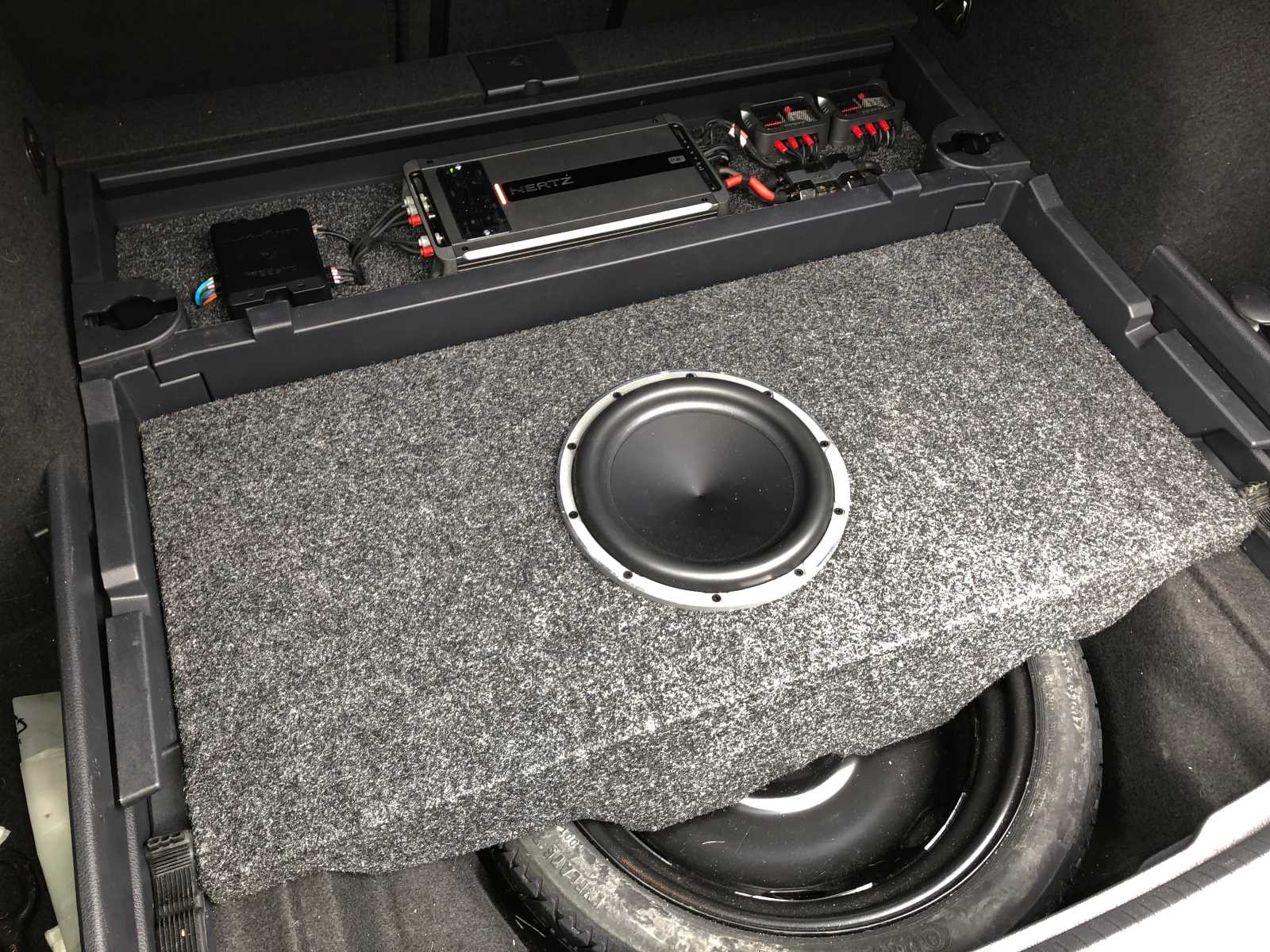
Mount the subwoofer box in trunk or cargo area so it stays put. You will want to mount subwoofer box in trunk to prevent dangerous shifting during sharp turns or hard braking. One method runs ½‑inch diameter bolts through the bottom of the cabinet and the vehicle floor. Add flat and lock washers underneath to prevent loosening. Drill only holes large enough for the bolts. Apply silicone sealant and flat washers inside the cabinet to stop air leaks. If you prefer not to drill through the metal, bolt L‑brackets to the cargo floor and then to the cabinet. Another option uses an adjustable strap anchored to interior tie‑downs to secure subwoofer box in trunk without piercing the cabinet itself. Whichever route you choose, the goal is to keep subwoofer box from sliding during sudden stops. This also protects the driver from the box becoming a projectile.
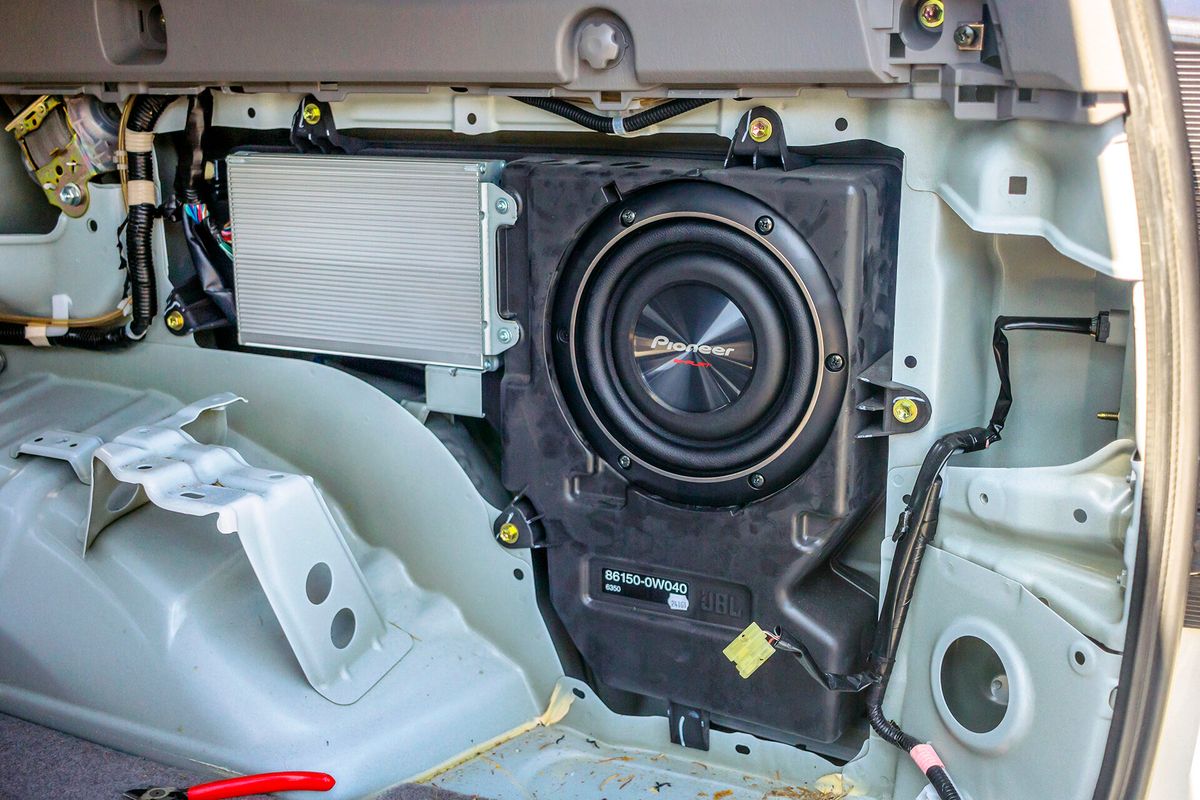
Before locking it down, experiment with which way should subwoofer face in trunk for the strongest, cleanest response in your specific vehicle. Test a few positions against the back seat. Cabin acoustics vary, so invest the time in testing. Truck owners face a different challenge. When you build a truck subwoofer box, custom boxes can be designed for specific vehicles, including under the rear seats of a crew cab truck. Use every available inch of a correctly sized cabinet. Never drill anywhere you could hit a fuel tank or brake line. Keep spare‑tire access clear no matter how the box is fastened.
Related audio projects
Once your subwoofer cabinet is dialed in, the rest of the signal chain determines whether you hear tight transients or muddy rumble. Many builders pair a custom box with the decision to build a stereo tube amp, whose natural compression and even-order harmonics can soften the clinical edge of a solid-state bass path without sacrificing impact. On the source side, iPhone owners can shape the low end before the signal ever leaves the phone by going to Settings > Accessibility > Audio & Visual, opening the Headphone Accommodations menu, and choosing a Frequencies tuning option that emphasizes bass, then going to Settings > Apps > Music > EQ to apply its own sculpting tools. Android users on a Pixel with version 10 or newer should navigate to Settings > Connected devices > Saved devices > [their Pixel Buds] > Sound > Equalizer and select the Boost bass preset, or open the Pixel Buds app and apply the Heavy bass curve there. If you are building a mid-bass array to fill the gap between your sub and front stage, you must choose the right 6x9 speakers for deep bass.